
Highlights:
It is one of the most common questions asked by anyone who owns a cat and is considering a German Shepherd, or owns a German Shepherd and is thinking about adding a cat. And the honest answer is the one nobody likes to hear: it depends.
It depends on the individual temperament of both animals, the age at which they meet, the quality of training the dog has received, and how carefully the introduction is handled. German Shepherds are loyal, attentive, and highly trainable, which gives them a real advantage in learning to coexist with cats. But the breed also carries a working-dog drive that, without proper management, can turn a curious sniff into a chase. Understanding the difference is everything.
This guide separates the myths from the facts and walks through exactly how to give a German Shepherd and a cat the best possible chance at a peaceful household.
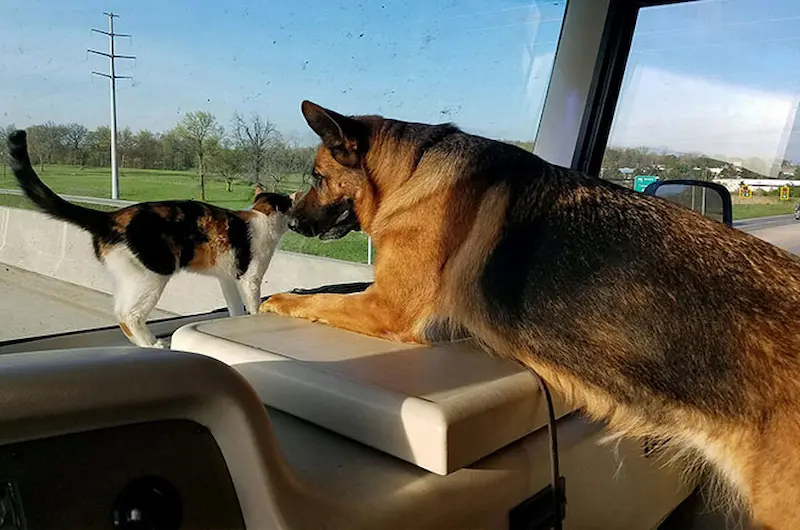
Myth Vs. Fact: What People Get Wrong About GSDs & Cats
A lot of the advice floating around about German Shepherds and cats is based on assumption rather than how these animals actually behave. Here are the most common misconceptions, set against reality.
| Common Myth | The Reality |
| German Shepherds always see cats as prey | Prey drive varies by individual; many GSDs coexist calmly with proper training |
| If they fight once, they will never get along | A bad first meeting means slow down, not give up |
| A dog wagging its tail at a cat means friendship | Excitement is not the same as friendliness and can precede a chase |
| Puppies and cats always become best friends | Early introductions help, but puppies still need firm boundaries |
| Once they tolerate each other, supervision can stop | Unsupervised time is never fully safe given the size difference |
| Punishing the dog for reacting teaches it to behave | Punishment increases anxiety and can worsen the cat association |
The throughline here is that success comes from management and realistic expectations, not from assuming the worst or hoping for the best.
What Determines Whether A German Shepherd Tolerates Cats
There is no single trait that decides this. It is a combination of factors, and understanding each one helps you set realistic expectations for your own household.
Temperament is the biggest variable. Some German Shepherds are naturally calm and unbothered by small, fast-moving animals. Others have a strong prey drive that makes a darting cat almost irresistible to chase. Neither is a character flaw, but they require different levels of management.
Age at introduction matters too. A puppy introduced to a cat tends to adapt more easily than an adult dog meeting a cat for the first time. That said, puppies bring their own challenge. They chase, pounce, and play-bite, and they get overexcited easily. That excitement can terrify a cat, sending it into hiding or provoking a defensive swat, hiss, or scratch. So while a puppy may be more adaptable, it still needs clear boundaries from day one.
Training is the factor you have the most control over. A German Shepherd that reliably responds to basic commands like sit, stay, and leave; it is far easier to manage around a cat than one without that foundation. Early, positive socialization builds on this, but it has to be a good experience for both animals, not a stressful one.
The Warning Signs Your GSD Is Not Ready To Meet A Cat
Before you ever let a German Shepherd near a cat, you need to be able to read whether the dog is in a calm, receptive state or a fixated, aroused one. Certain behaviors are clear signals that the dog is not ready and that the introduction needs to slow down.
Watch for an intense, fixed stare locked onto the cat, a stiff and rigid body posture, barking or whining directed at the cat, pulling hard on the leash toward it, and stalking behavior such as crouching and creeping forward. Another major red flag is when the dog ignores treats or commands entirely because it is too focused on the cat to respond to you. If your German Shepherd is doing any of these things, it is too aroused for a safe meeting.
None of this means your dog can never live with a cat. It simply means the introduction has to be taken more slowly and carefully, with more time spent at each earlier stage before moving forward.
How To Introduce A German Shepherd & A Cat The Right Way
A proper introduction is a gradual process that can take days or weeks, and rushing it is the most common reason these introductions fail. Here is how to structure it.
Start with complete separation. Keep the cat in a safe, dedicated room with everything it needs: food, water, a litter box, a comfortable bed, and places to hide. The two animals should not see each other at first. This gives the cat a secure base and lets both animals get used to the sounds and smells of the other before any visual contact.
Let them learn each other’s scent. Scent is how both species gather information about a newcomer. Swap bedding or gently rub a cloth on one animal and place it near the other. Reward calm interest in the scent so each animal begins to associate the other’s smell with good things.
Introduce a visual barrier. Once both animals are relaxed about the scent, allow them to see each other through a barrier like a baby gate. Reward the German Shepherd for calm, non-hostile attention toward the cat, and reward the cat for staying relaxed. Keep these sessions short and positive.
Move to leashed, in-room meetings. When both animals are consistently calm with the barrier, bring them into the same space with the dog on a leash. Use simple commands like sit and stay to confirm the dog is still responsive and in a good frame of mind. Let the cat move freely and never force it toward the dog. Keep sessions short and always end while both animals are still calm, not after tension has built up.
The pace is dictated by the animals, not the calendar. If either one shows stress, you drop back to the previous stage and spend more time there.
The Mistakes That Can Ruin A German Shepherd & Cat Relationship
Even well-intentioned owners can sabotage the process. These are the errors most likely to set things back or create lasting problems.
Punishing the dog for reacting to the cat. If the German Shepherd lunges, barks, or pulls toward the cat and you punish it, the dog can begin to associate the cat itself with something negative. This increases anxiety and can make the relationship worse, not better. Instead, redirect calmly and reward the behavior you want to see.
Leaving them alone together too soon, or at all. This is the most dangerous mistake. A German Shepherd is large and powerful enough to seriously injure or kill a cat, even unintentionally during play. Until trust is fully and consistently established, the two should never be left unsupervised, and many owners maintain separation when they are not home regardless of how well things are going.
Mistaking excitement for friendship. A German Shepherd that is bouncy, alert, and eager around a cat is not necessarily being friendly. High arousal can flip from playful to predatory in an instant, and what starts as wanting to sniff the cat can become wanting to chase it. Calm, relaxed body language is the goal, not excitement.
Forcing the interaction. Never push either animal toward the other. Forcing proximity creates fear and defensiveness, and a cornered cat will lash out while a pressured dog becomes more aroused. Let both animals set the pace.
What To Realistically Expect Over The First Weeks & Months
Patience is the single most important ingredient. A peaceful German Shepherd and cat household is absolutely achievable, but it rarely happens in a few days. For many pairs, genuine comfort takes weeks, and full trust can take months.
Some pairs progress to genuine affection, grooming each other and sleeping in the same room. Others reach a state of calm mutual tolerance, where they coexist without conflict but largely keep to themselves. Both outcomes are successes. What matters is that neither animal is stressed, frightened, or at risk.
Throughout the process, keep giving each animal individual attention so neither feels displaced by the other. Maintain the cat’s safe spaces and high perches permanently, since having a reliable escape route is a big part of what keeps a cat confident and calm around a dog.
How Temperament & Breeding Shape A German Shepherd’s Success With Cats
A German Shepherd’s baseline temperament, including its prey drive and natural disposition, is heavily influenced by genetics and breeding. Dogs bred for balanced, stable temperament rather than extreme drive tend to adapt more easily to multi-pet households, and a sound temperament makes every part of the introduction process easier and safer. At Mittelwest, every breeding pair is selected from world-class German bloodlines for balanced temperament, trainability, and stability alongside health and structure, giving each puppy the kind of even disposition that helps it thrive in a home with other animals.

Julie Martinez is a German Shepherd breeder and the owner of Mittelwest German Shepherds in Wonder Lake, Illinois. She breeds German Shepherd Dogs under the “vom Mittelwest” kennel name and is listed as a breeder on the AKC Marketplace. Through her breeding program, Julie focuses on German-bred bloodlines and works with owners who value structure, temperament, and real-world working ability. She is also involved in local working-dog training through the Wonder Lake Schutzhund Club, where Mittelwest supports hands-on development such as tracking and club training.